
Why Most Resumes Fail
The 8-Second Test Every Job Seeker Needs to Understand Click here for Job Search Information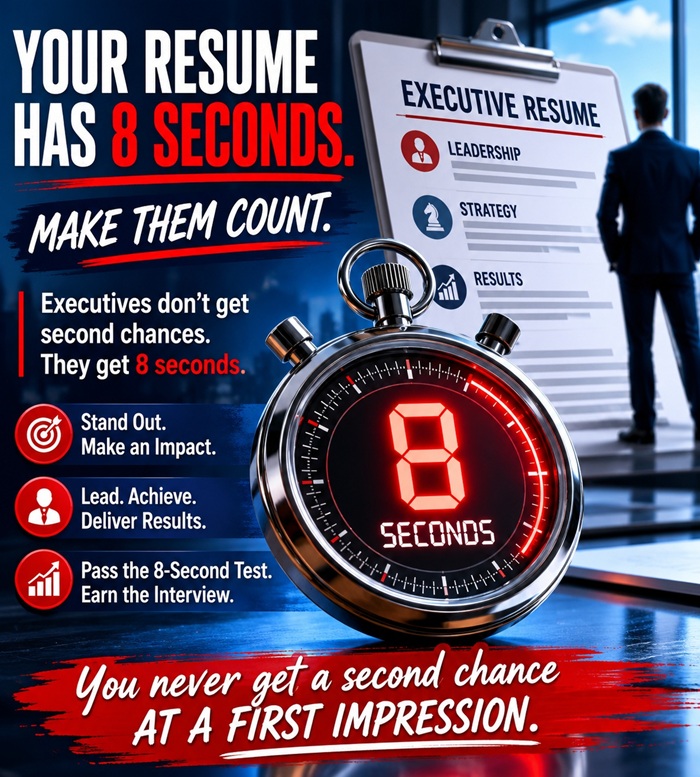
You spent hours updating your resume.
You carefully documented your experience, listed your responsibilities, polished the formatting, and hit “Apply.”
Then nothing happened.
No interview.
No phone call.
No response.
If this sounds familiar, you’re not alone.
One of the biggest reasons resumes fail is that they don’t pass the 8-second test.
Your Resume Has Just 8 Seconds
Most recruiters and hiring managers are reviewing dozens, sometimes hundreds, of resumes for a single position.
They aren’t reading every word.
They’re scanning.
In the first few seconds, they’re looking for evidence that you’re a strong fit for the role. If they can’t quickly identify your value, they’ll move on to the next resume.
Think about your own online behavior. When you visit a website, do you read every word on the page?
Probably not.
You scan the headlines, look for key information, and decide whether it’s worth your time to continue.
Recruiters do exactly the same thing with resumes.
What Recruiters Are Looking For
Within eight seconds, a recruiter should be able to answer the following questions:
Who is this person?
Your professional identity should be immediately clear.
Examples:
- Chief Financial Officer
- Vice President, Operations
- Commercial Leader
- Human Resources Executive
- Digital Transformation Leader
What do they do?
Your area of expertise should be obvious.
Examples:
- Business Development
- Marketing
- Supply Chain
- Finance
- Talent Acquisition
- Information Technology
Why should I keep reading?
This is where most resumes fail.
Recruiters want evidence of impact.
They want to see results.
They want to know what makes you different from the hundreds of other candidates who applied.
The Six Reasons Most Resumes Fail
1. They Read Like Job Descriptions
Many resumes simply list responsibilities.
The problem is that responsibilities don’t differentiate you from anyone else who held a similar role.
For example:
Weak Example
Managed a team of sales representatives across Canada.
Strong Example
Increased annual revenue by 38% and expanded market share across Canada by leading a high-performing sales team of 25 professionals.
The first tells us what you did.
The second tells us why it mattered.
Hiring managers hire impact.
2. They Lead With Tasks Instead of Results
Too many candidates focus on activities rather than outcomes.
Organizations hire people to solve problems, improve performance, and create value.
Ask yourself:
- How much revenue did I generate?
- How much money did I save?
- How did I improve efficiency?
- What strategic initiatives did I lead?
- What measurable outcomes did I deliver?
The answers to those questions belong on your resume.
3. They Hide Their Best Accomplishments
Many professionals bury their most impressive achievements halfway down the page.
Unfortunately, most recruiters never get that far.
Your strongest accomplishments should be highly visible and easy to find.
Think of your resume as a billboard.
The most important message should be visible immediately.
4. They Lack Executive Presence
This is especially common among senior leaders.
A Vice President, Senior Director, or C-Suite executive should not have a resume that reads like a list of operational activities.
Executive resumes should demonstrate:
- Enterprise-wide impact
- Strategic leadership
- Revenue growth
- Operational transformation
- Team leadership
- P&L accountability
- Organizational influence
Senior leaders are hired for the results they create, not the meetings they attended.
5. They Aren’t Optimized for ATS Systems
Before your resume reaches a recruiter, it may first be reviewed by an Applicant Tracking System (ATS).
These systems search for relevant skills, keywords, certifications, and industry terminology.
If your resume doesn’t contain the language employers are searching for, it may never reach a human reviewer.
ATS optimization is not about stuffing keywords into your resume.
It’s about ensuring your expertise is clearly communicated using language relevant to the role.
6. They Make the Reader Work Too Hard
Recruiters are busy.
The harder your resume is to read, the less likely it is to succeed.
Common problems include:
- Dense paragraphs
- Excessive text
- Poor organization
- Weak formatting
- Lack of measurable accomplishments
A strong resume is easy to scan and easy to understand.
How to Pass the 8-Second Test
Before submitting your resume, perform this simple exercise.
Look at your resume for only eight seconds.
Then ask yourself:
- Can I immediately tell what level this person operates at?
- Is their expertise obvious?
- Are their accomplishments easy to find?
- Do I understand the value they bring?
- Would I want to learn more?
If the answer to any of those questions is “no,” your resume likely needs improvement.
The Purpose of a Resume
Many people believe a resume is a document that tells the story of their career.
It isn’t.
A resume is a marketing document.
Its purpose is not to tell your entire story.
Its purpose is to generate enough interest to secure an interview.
Every section, every accomplishment, and every word should answer one question:
Why should we interview this person?
If it doesn’t contribute to that answer, consider removing it.
Final Thoughts
The reality is simple.
You don’t get 30 minutes to explain your value.
You don’t get a second chance at a first impression.
You get approximately eight seconds.
The resumes that generate interviews are not necessarily written by the most qualified candidates.
They are written by candidates who communicate their value clearly, quickly, and effectively.
Lead with impact.
Show measurable results.
Make your accomplishments impossible to miss.
And most importantly, make sure your resume passes the 8-second test.